
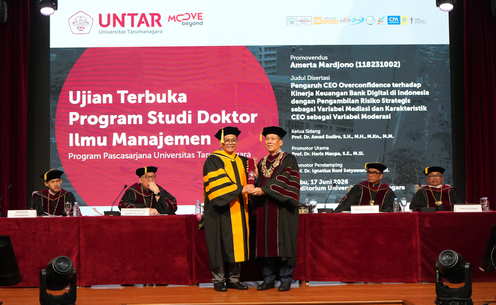
“Digital transformation has driven the emergence of digital banks as key actors in Indonesia’s financial industry. This condition presents new dynamics in strategic decision-making, including how CEO characteristics can influence corporate risk and financial performance,” said doctoral candidate Amerta Mardjono during the open doctoral defense of Untar’s Doctor of Management Science Program, Wednesday (17/6/2026), at Untar Campus I.
On this occasion, Amerta Mardjono, who currently serves as Senior Country Officer at the International Finance Corporation (IFC), successfully defended his dissertation entitled “The Influence of CEO Overconfidence on the Financial Performance of Digital Banks in Indonesia with Strategic Risk-Taking as a Mediating Variable and CEO Characteristics as a Moderating Variable” and officially earned the Doctor of Management Science degree as the 27th graduate of Universitas Tarumanagara’s Doctor of Management Science Program with the predicate “With Distinction.”
The dissertation was supervised by Main Promoter Prof. Dr. Haris Maupa, S.E., M.Si. and Co-Promoter Prof. Dr. Ignatius Roni Setyawan, S.E., M.Si. This study examines the influence of CEO Overconfidence, strategic risk-taking, and financial performance in digital banks in Indonesia using the perspectives of Upper Echelons Theory, Agency Theory, and Stakeholder Theory.
In his presentation, the doctoral candidate explained that CEO Overconfidence refers to the tendency of corporate leaders to have excessive confidence in assessing their capabilities, prospects, and strategic decisions. In the fast-moving digital banking industry, this characteristic can encourage bold decision-making, but may also increase risk exposure if it is not balanced with adequate governance and risk management.
This study used panel data from the seven largest digital banks in Indonesia during the 2014–2024 period, applying the Partial Least Squares-Structural Equation Modelling (PLS-SEM) approach. The findings show that CEO Overconfidence has a positive and significant effect on strategic risk-taking and can directly improve financial performance.
However, the study also found that strategic risk-taking has a negative and significant effect on financial performance. This finding indicates that bold risk-taking does not always lead to increased profitability, particularly when a company does not yet have strong risk management capacity, governance, and prudential discipline.
In addition, the study shows that strategic risk-taking serves as the main mechanism explaining how the negative consequences of CEO Overconfidence can be translated into corporate financial performance. In other words, excessive CEO confidence may drive strategic boldness, but its impact on performance depends greatly on the quality of decision-making and organizational risk management.
In terms of moderation, the study found that CEO age does not have a significant effect. Meanwhile, CEO gender strengthens the relationship between CEO Overconfidence and strategic risk-taking, and also strengthens the negative effect of strategic risk-taking on financial performance in companies led by male CEOs.
Through this research, the doctoral candidate emphasized the importance of strengthening governance, risk-based supervision, and evaluation of top management’s strategic behavior in the digital banking industry. The findings are expected to contribute to regulators, boards of commissioners, investors, and digital bank management in maintaining a balance between strategic boldness, innovation, and the stability of corporate financial performance. (JAT)