
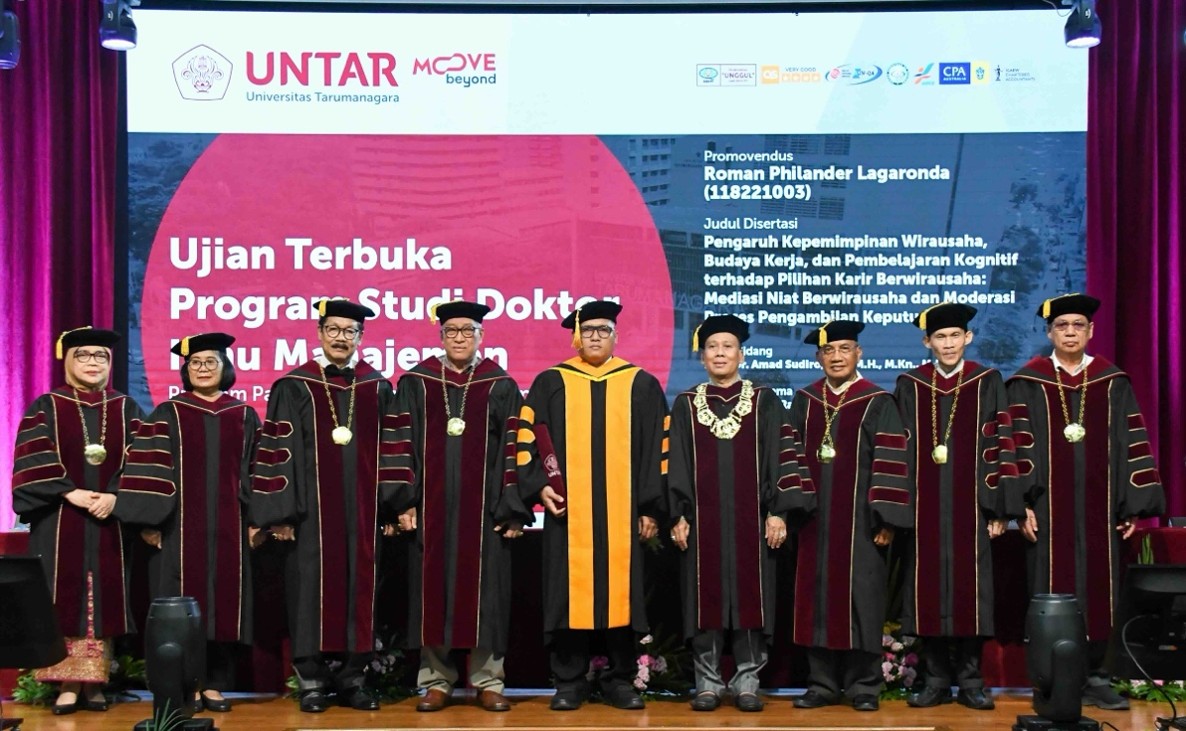
The Doctoral Program in Management Science at Universitas Tarumanagara (Untar) held an open doctoral promotion examination at Untar Campus I on Friday (09/01/2026). During the examination, Promovendus Roman Philander Lagaronda officially earned the 22nd Doctoral Degree in Management Science from Untar with the predicate “Very Satisfactory”.
Roman Philander Lagaronda defended his dissertation entitled “The Influence of Entrepreneurial Leadership, Work Culture, and Cognitive Learning on Entrepreneurial Career Choice: The Mediation of Entrepreneurial Intention and the Moderation of the Decision-Making Process”. This study focuses on entrepreneurial career choice among migrant and Indigenous Papuan micro, small, and medium enterprise actors in Papua.
In his research, Roman Philander Lagaronda examined the influence of entrepreneurial leadership, work culture, and cognitive learning on entrepreneurial career choice, with entrepreneurial intention as a mediating variable and the decision-making process as a moderating variable. The study involved 450 MSME actors in Jayapura City, Sentani City, and Arso City.
The findings show that entrepreneurial leadership, work culture, and cognitive learning have a positive and significant influence on entrepreneurial career choice. Cognitive learning was found to be the strongest influencing factor, followed by work culture and entrepreneurial leadership. In addition, entrepreneurial intention was proven to mediate the relationships among variables, while the decision-making process strengthened the influence of entrepreneurial intention on entrepreneurial career choice.
Roman Philander Lagaronda currently serves as a lecturer in the Management Study Program at Universitas Ottow Geissler Papua. Through this research, he highlights the importance of strengthening entrepreneurial capacity, productive work culture, cognitive learning, and the quality of decision-making in encouraging more inclusive and sustainable entrepreneurial career choices in Papua.
Roman Philander Lagaronda hopes that his research findings can serve as input for the government, educational institutions, and relevant stakeholders in designing more targeted entrepreneurship empowerment programs. He also hopes that this study can encourage MSME actors, both migrant communities and Indigenous Papuans, to become more confident in making entrepreneurship a competitive and sustainable career choice. (JAT)