
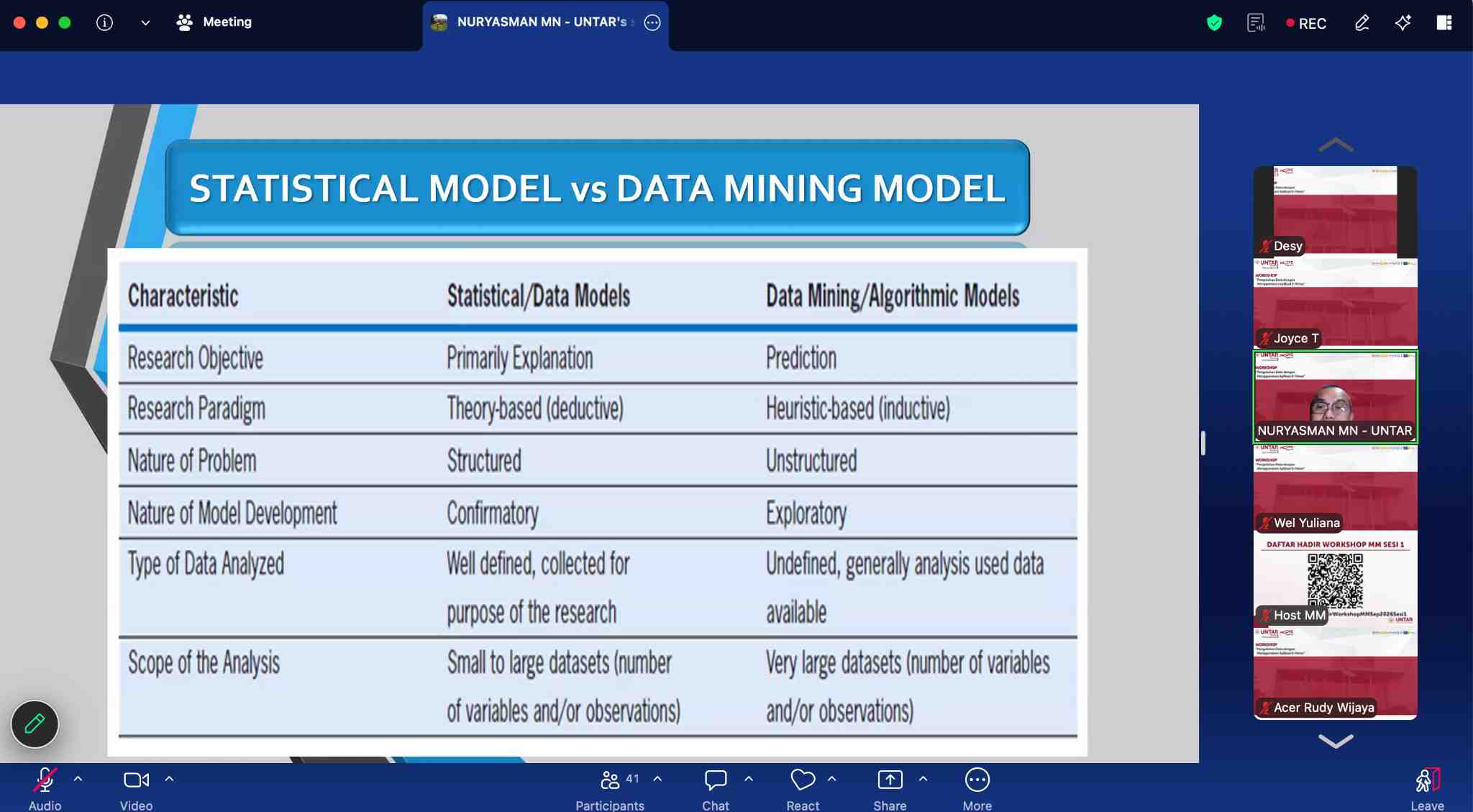
Jakarta, September 21, 2026 – The Master of Management Study Program at Universitas Tarumanagara (Untar) held an online workshop entitled “Data Processing Using EViews” via Zoom in two sessions on September 14 and 21, 2026. Featuring Dr. Nuryasman MN., S.E., M.M., a lecturer at Untar’s Faculty of Economics and Business, the workshop was part of the program’s efforts to strengthen students’ methodological competencies in producing higher-quality and more relevant research.
The workshop was designed as two interconnected sessions, enabling participants not only to develop skills in using the software but also to understand the methodological foundations underlying each stage of the analytical process.
The first session, held on September 14, 2026, focused on conceptual understanding. Participants learned about the structures of cross-sectional data, time-series data, and panel data, as well as the characteristics of three panel data regression approaches: the Common Effect Model (CEM), Fixed Effect Model (FEM), and Random Effect Model (REM).
During this session, students also learned the fundamentals of selecting an appropriate panel data model through the Chow Test, Hausman Test, and Lagrange Multiplier Test. This understanding is essential to ensure that students do not merely follow technical data-processing procedures but are also able to understand the methodological reasoning behind the selection of a particular model in their research.
Building on this conceptual foundation, the second session on September 21, 2026, focused on hands-on practice using EViews. Students applied the concepts they had learned, ranging from preparing and importing data and creating a workfile to conducting descriptive statistics and correlation analysis, as well as estimating CEM, FEM, and REM.
The practical session used a case study based on financial statement data from listed companies. Participants carried out the stages of data processing, conducted model selection tests, interpreted estimation results, and drew scientific conclusions based on the selected model.
The impact of this activity extends beyond improving students’ ability to operate EViews. Through the integration of conceptual understanding and hands-on practice, students were equipped with the ability to select appropriate analytical methods, critically interpret test results, and justify methodological decisions in their research. These competencies are particularly important in supporting thesis preparation and further research development among Master of Management students.
The workshop also reflects the commitment of Untar’s Master of Management Study Program to providing impactful learning experiences by connecting academic methodological understanding with analytical skills that can be directly applied to research. In this way, students are expected not only to become users of analytical tools but also to develop as researchers who understand the processes, decision-making rationale, and interpretation behind every data analysis result.
Through academic activities that integrate concepts, practice, and real-world application, Untar’s Master of Management Study Program continues to foster learning experiences that directly contribute to enhancing students’ competencies and the quality of their research. (JAT)