
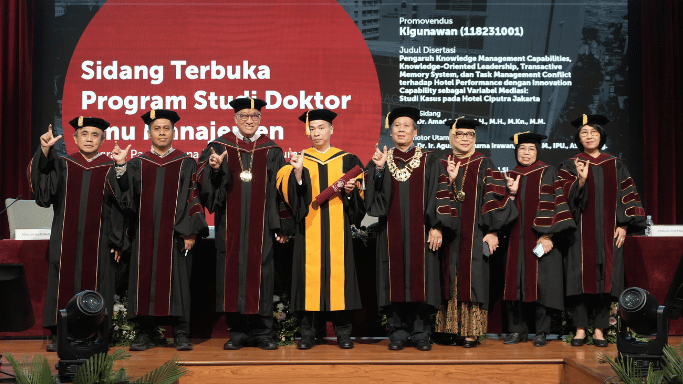
Jakarta, October 30, 2026 – Kigunawan, a doctoral candidate in the Doctoral Program in Management at the Graduate Program of Universitas Tarumanagara (Untar), examined the importance of knowledge management, knowledge-oriented leadership, team coordination, and task conflict management in fostering innovation and improving organizational performance in the hospitality industry.
His dissertation, entitled “The Influence of Knowledge Management Capabilities, Knowledge-Oriented Leadership, Transactive Memory System, and Task Management Conflict on Hotel Performance with Innovation Capability as a Mediating Variable: A Case Study at Hotel Ciputra Jakarta,” investigated how organizational resources and capabilities contribute to hotel performance through innovation.
The study was motivated by the increasingly competitive hospitality environment, which requires hotels to continuously adapt, strengthen operational effectiveness, improve service quality, and develop innovative capabilities. In this context, effective knowledge management and the integration of employees’ expertise are essential to sustaining organizational competitiveness.
Innovation Capability as a Driver of Hotel Performance
Kigunawan’s research examined the effects of four organizational factors, namely Knowledge Management Capabilities, Knowledge-Oriented Leadership, Transactive Memory System, and Task Management Conflict, on hotel performance, both directly and through the mediating role of Innovation Capability.
The study adopted a quantitative approach involving 165 employees of Hotel Ciputra Jakarta, drawn from a population of 278 employees. Data were collected through questionnaires and analyzed using Partial Least Squares Structural Equation Modeling (PLS-SEM) with SmartPLS software.
The findings revealed that all four organizational factors had positive and statistically significant effects on both Innovation Capability and Hotel Performance. Furthermore, Innovation Capability demonstrated a positive and significant effect on Hotel Performance and served as a partial mediator in the relationships between the four organizational factors and hotel performance.
Implications for Hospitality Management
The findings emphasize that improving hotel performance requires more than service quality and operational efficiency. It also depends on an organization’s ability to manage knowledge, cultivate effective leadership, strengthen team coordination, and address task-related disagreements constructively.
Effective knowledge management enables organizations to acquire, share, and utilize employee expertise to support service improvements and organizational innovation. Meanwhile, knowledge-oriented leadership fosters a work environment that encourages learning, collaboration, and the development of new ideas.
The study also highlights the importance of transactive memory systems, which reflect employees’ shared understanding of the expertise and responsibilities within their teams. Such systems can improve coordination, knowledge integration, and innovation.
In addition, task management conflict, when managed constructively, can encourage the exchange of diverse perspectives and facilitate alternative solutions to organizational challenges.
These findings establish Innovation Capability as a critical mechanism linking organizational resources and managerial practices to sustainable improvements in hotel performance.
Academic and Practical Contributions
Kigunawan conducted his doctoral research under the supervision of Prof. Dr. Ir. Agustinus Purna Irawan, M.T., M.M., I.P.U., ASEAN Eng., as the principal supervisor, together with Prof. Dr. Haris Maupa, S.E., M.Si. and Dr. Miharni Tjokrosaputro, S.E., M.M. as co-supervisors.
From an academic perspective, the study contributes to the literature on strategic management, knowledge management, leadership, and organizational innovation. From a practical perspective, its findings provide valuable insights for hospitality managers seeking to develop knowledge-driven and innovation-oriented performance improvement strategies.
The research also reflects the commitment of the Doctoral Program in Management at Universitas Tarumanagara to advancing scholarly contributions that address contemporary industry challenges and strengthen organizational competitiveness. (JAT)