
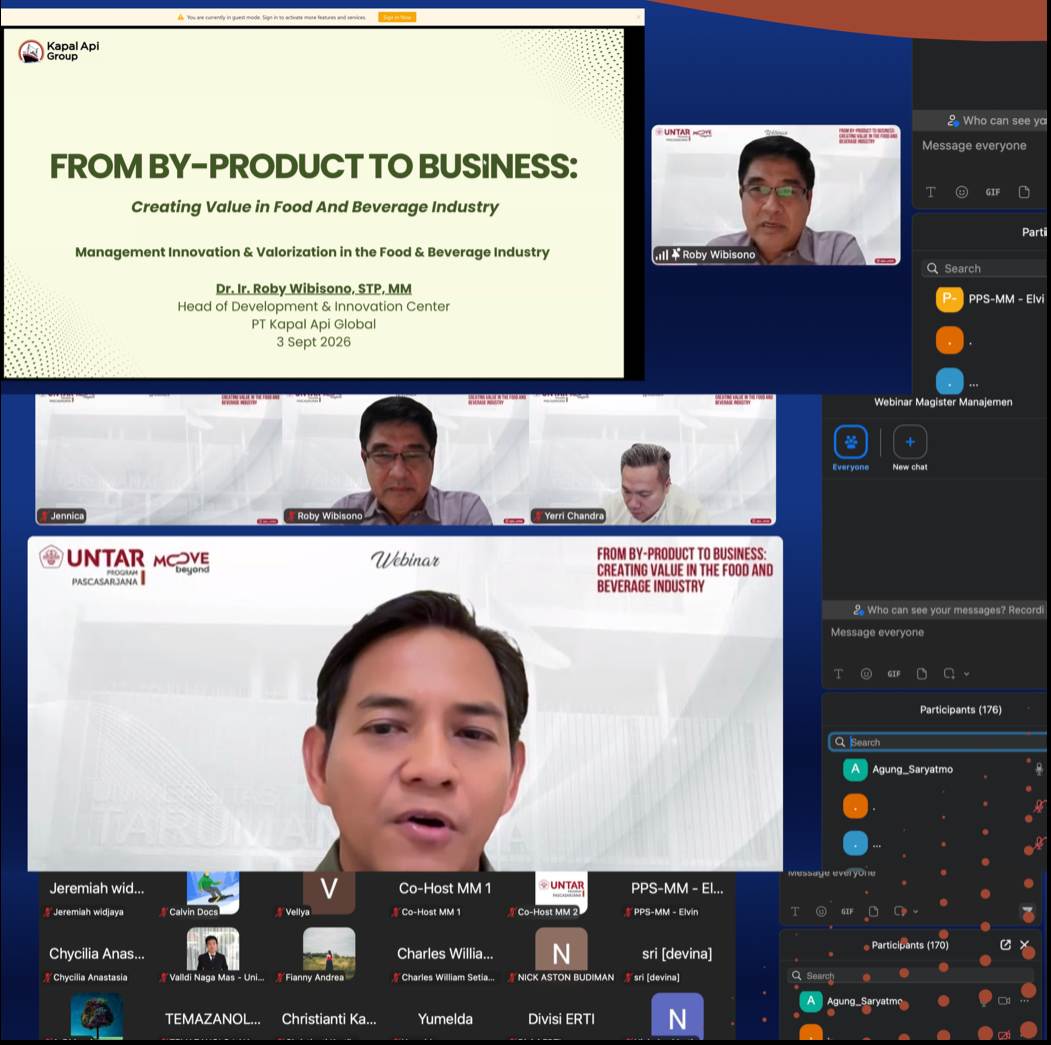
Jakarta, September 3, 2026 – The Master of Management Study Program at Universitas Tarumanagara (Untar) held a webinar entitled “From By-Product to Business: Creating Value in the Food and Beverage Industry” on Thursday, September 3, 2026. The webinar featured Dr. Ir. Roby Wibisono, S.TP., M.M., Head of the Development & Innovation Center at PT Kapal Api Global, as the guest speaker, with Dr. Ir. M. Agung Saryatmo, S.T., M.T., Ph.D. serving as moderator.
The webinar explored how by-products generated in food and beverage production processes do not necessarily have to end up as waste. Through innovation and proper management, materials that were previously considered to have little or no value can be transformed into resources that generate economic benefits while supporting industrial efficiency and sustainability.
In his presentation, Roby explained that creating value from by-products begins with a change in perspective. Companies should not only ask how residual materials can be properly handled or responsibly disposed of, but also examine their remaining properties, potential functions, and the needs that these materials may be able to address.
The business value of utilizing by-products does not necessarily have to come from selling a new product. Value can also be created through cost avoidance, cost reduction, risk reduction, as well as new opportunities for growth and competitive advantage.
One example discussed during the webinar was the utilization of spent coffee grounds generated through the coffee extraction process. This material can be developed for various purposes, ranging from fuel and industrial raw materials to other value-added products.
In practice, PT Kapal Api Global utilizes spent coffee grounds as part of its fuel through a co-firing process to partially substitute coal. This utilization has the potential to reduce waste-management burdens, improve resource efficiency, and support cost savings. Spent coffee grounds are also being developed as a raw material for fertilizer, enabling material that was previously considered a waste-management burden to gain new functions and value.
Roby also emphasized that material potential alone is not sufficient to create business value. New opportunities can be realized when material potential, real needs, and implementation readiness come together. Safety, consistency, feasibility, market needs, and industrial readiness are therefore important considerations before an innovation can be implemented sustainably.
The discussion was further expanded from a managerial perspective, covering business feasibility, make, partner, or sell strategies, approaches to measuring innovation success, and the balance between revenue, cost reduction, waste reduction, environmental impact, and strategic value for the company.
Through this webinar, the Untar Master of Management Study Program encouraged participants to view innovation not only as the creation of new products, but also as the ability to discover new functions and value from existing resources. This approach can strengthen economic and environmental impact through improved efficiency, reduced waste-management burdens, and the creation of new business opportunities.
A key message highlighted throughout the webinar was that a by-product can become a business opportunity when its potential responds to a real need and can be implemented consistently. Innovation therefore does not stop at technical feasibility, but must also be supported by appropriate strategy, collaboration, implementation readiness, and business models. (JAT)